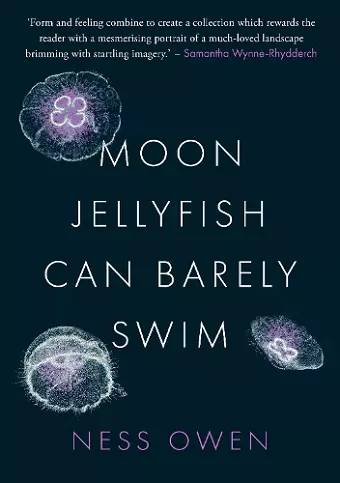
Moon Jellyfish Can Barely Swim
Format:Paperback
Publisher:Parthian Books
Published:3rd Apr '23
Should be back in stock very soon
'Sometimes in a writer's life an image arrives, unasked, and inhabits us, breeding connections through every compartment of our minds. This new collection by Ness Owen feels like one of those, with childhood memory, family, the politics of language, sense of place and an urgent environmental concern beyond human boundaries interwoven and embodied by the sight of that most liminal thing, a stranded jellyfish. It seems the slightest of lives, adrift, less flesh than water. And yet, like these poems, it can sting.' - Philip Gross
Rooted in her island home, Ness Owen's second collection explores what it is to subsist with whatever the tides bring in poems that journey from family to politics, womanhood and language.Moon jellyfish live a life adrift, relying on the current to take them where they need to go. They are the ultimate survivors and one of the most successful organisms of animal life. So how do they thrive in the open ocean when they can barely swim? Rooted in her island home, Ness Owen's second collection explores what it is to subsist with whatever the tides bring in poems that journey from family to politics, womanhood and language. In the ebb and flow of an ever-changing world, starlings fall from the sky, votes are cast, a village is drowned, a petrified forest is revealed and messages wash up in seaworn bottles on the shoreline, waiting for answers that will not come.
Moon jellyfish are 95% water. They have no brain. They live their brief lives being led by the current because, as the title of Ness Owen’s latest poetry collection states, moon jellyfish can barely swim. They are, however, referred to as one of the most successful organisms. What does this tell us? How should this knowledge impact on human life and how we act? In Moon Jellyfish Can Barely Swim, Owen tackles these questions and more. This, her second published collection of poetry, is somewhere floating between classical metaphysical poetry and contemporary ecological flag-waving verse. Like the titular jellyfish, Owen’s verse floats effortlessly between the two to create something unique and beautiful. The overriding theme in these poems is ‘resistance’. There is a natural beauty in the complete lack of resistance from the jellyfish and the way they are at the mercy of their surrounding currents, for example. Yet elsewhere resistance is vital. Resistance to the damage man is doing to the sea and the natural world; resistance to forgetting the past; resistance to guidelines and society. Resistance, in its many forms, is the heart of this collection, and finding the right balance between ‘going with the flow’ and fighting back seems to be the challenge it addresses. ‘Relax, stay calm and float’ is the quotation opening the third section of this collection, for example. Yet within this portion of the book are poems about protesting (‘How to Protest’ and ‘Caernarfon March’) and the importance of remembering injustice (‘Cofiwch’). Staying calm and floating on seems to be the issue here, rather than the answer. Owen lives and works on Anglesey, and the sea, the coast and its natural forces are throughout her work. So much so, in fact, that it’s not even 25 pages before Owen knowingly presents her reader with ‘Not Another Sea Poem’. It’s a vital poem, and an angry poem, that ends with the unapologetic, ‘Between these lines you won’t hear the breaking wave scream stop dumping your shit in the sea.’ Elsewhere ‘Empty Beach Clean’ opens, ‘This year we only find left-footed shoes’, opening up the image of endless shoes dumped in the sea. This feels like a call to action, rather than ‘going with the flow’. One of the most interesting pieces in this collection is ‘And the goats came’, which, in the context of poetry reflecting on resistance, is beautifully ambiguous. ‘Down from Gogarth / leaving their mountain / like they’d always been / waiting to taste the / privet poison and take / back what was theirs.’ Poetry is often viewed as a very traditional and timeless art form, but this is contemporary and relevant. Portraying the time when mountain goats briefly became omnipresent in some north Wales towns due to Covid restrictions limiting human presence, this looks at nature vs man in a unique way. Sarcastic references to ‘second-home owners’, and what feel like self-deprecating comments on passiveness and following rules, sit alongside admiration for the goats. Is this a call to action for more resistance from us, or an ode to the active resistance shown by the goats? Ness Owen has written a challenging and contemporary collection of poetry here. Full of contrasts, images, and ideas. She uses deceptively simple images and themes from nature and north Wales, and raises questions and issues to which she doesn’t always provide answers. This is poetry as an active tool and not simply a linguistic mirror to society. Moon jellyfish can barely swim, but Ness Own knows exactly what she’s doing. -- Liam Nolan @ www.gwales.com
ISBN: 9781913640972
Dimensions: 210mm x 148mm x 12mm
Weight: unknown
108 pages